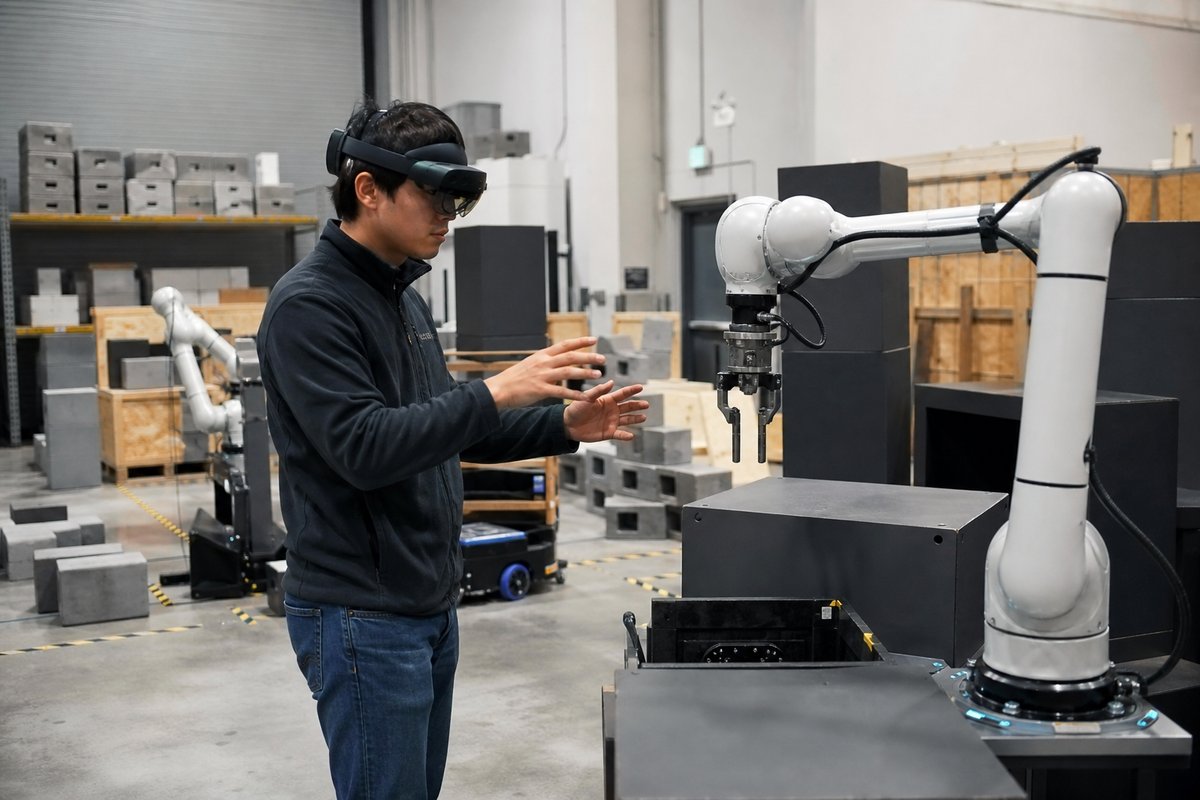
In a warehouse in San Leandro, California, Encord is experimenting with a new twist on robot training data: a headset that tracks a human pilot’s brain waves while he completes a simple Jenga-like task. The company, which already helps robotics firms annotate and evaluate data, is now trying to produce the kind of physical-world training material that many AI systems still lack.
That headset comes from Zander Labs, a German neuroscience startup that believes brain activity can reveal useful signals such as intent, error and surprise. Encord is currently treating the project as a trial. The plan is to build a small brain wave-tagged dataset, test whether it improves customer robotics models, and only then decide whether it is worth expanding. According to Zander neuroscientist Lucas Gehrke, the amount of brain activity seen during a task may also help model builders determine when to reserve their most capable systems for the hardest moments.
For Encord, the bigger story is the data bottleneck facing robotics. Vineeth Velmurugan, who leads robot learning at the company, says the challenge is no longer just model design but the lack of enough real-world examples to train them. He says many customers have shifted toward end-to-end learning for manipulation tasks, which means companies increasingly need to create their own datasets instead of simply organizing existing ones. In his view, the needed scale is enormous — roughly five times the size of YouTube’s video corpus — which is one reason data generation has become a business of its own.
Encord is collecting that data in several ways. One stream comes from “egocentric” video captured by workers wearing cameras, often paired with other sensors. Another comes from remote-controlled robots. At the San Leandro site, pilots were using leader-follower robotic arms to record tasks such as pouring coffee, stacking poker chips and handling ethernet cables in a server rack. The facility also stores props like fake flowers, books, plastic vegetables, kitty litter trays and bundles of wires to simulate household manipulation jobs. Velmurugan says many humanoid robotics teams have asked for these kinds of datasets.
The company is also testing forearm sensors that measure electrical signals in muscles, with the goal of reconstructing hand position more accurately than video alone can. Encord then adds detailed physical labels to its datasets, such as describing a motion as “right hand tightens bolt.” Velmurugan says that level of dense annotation can be far more valuable than basic ego video when training robots for specific tasks.
Source: techcrunch.com